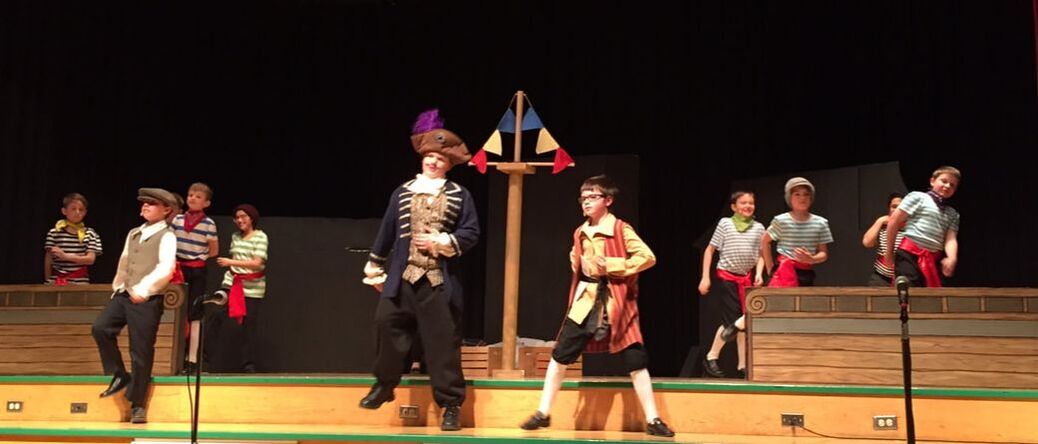
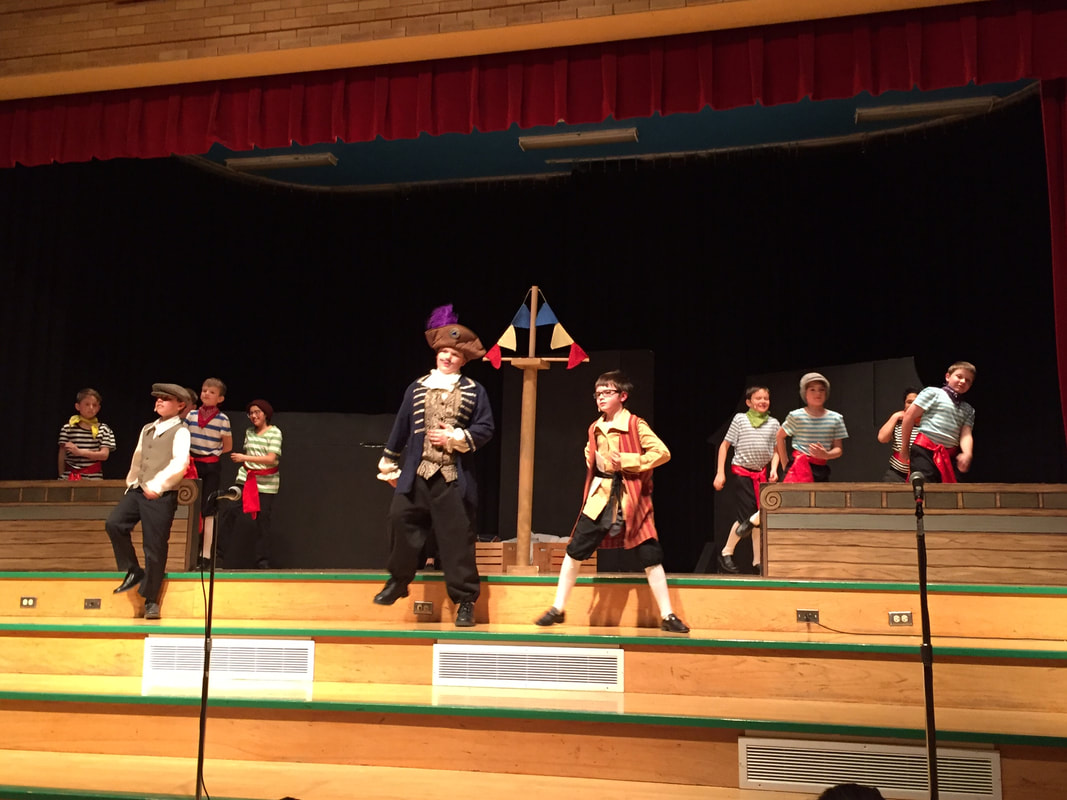
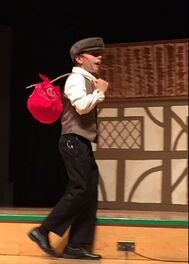
Cast of "The Adventures of Dick Whittington" 2016 But I sure miss those kids! They were great.
| BaileyKidsMusicals.com |
|
Cast of "The Adventures of Dick Whittington" 2016 Last night at my community choir rehearsal, my friend told me that her son had returned from his mission. That means that the little 4th grader who had been in some of my shows at his elementary school was grown up now, probably nearing age 21. What a talented kid. He brought to life some of the most complicated main characters I ever wrote. In fact all of those children who participated in the premiere performances of "Parizade's Quest" 2015 and "The Adventures of Dick Whittington" 2016 are all grown up and in college, on missions, working, or some are even married and starting families of their own. My how time does fly! I had first recognized Richard Stallard in the ensemble of "Never Cry Wolf" 2013. He stood out because he could sing, and move, and was willing to quickly do as directed. And he did things well. His brother had been in some earlier shows, and his sister came along later. All very talented. There were many kids in that school who were talented and willing to work. It was a joy to write new shows and unique characters for them. It is hard for me to believe now that these kids could handle sophisticated material including a lot of memorization, movement, sing well, and bring to life previously unknown characters. They allowed me to write (and edit on the spot) brand new material without any complaints. They indeed brought these shows to life. I am actually kind of sad that I removed myself from doing main stage shows for 4th-6th grades, drama club productions, and younger grade shows at that school. The building was going to go through a 2 year renovation (no stage), then my husband got sick, then COVID closed down everything. At the time, I just thought it best to "retire."
But I sure miss those kids! They were great.
0 Comments
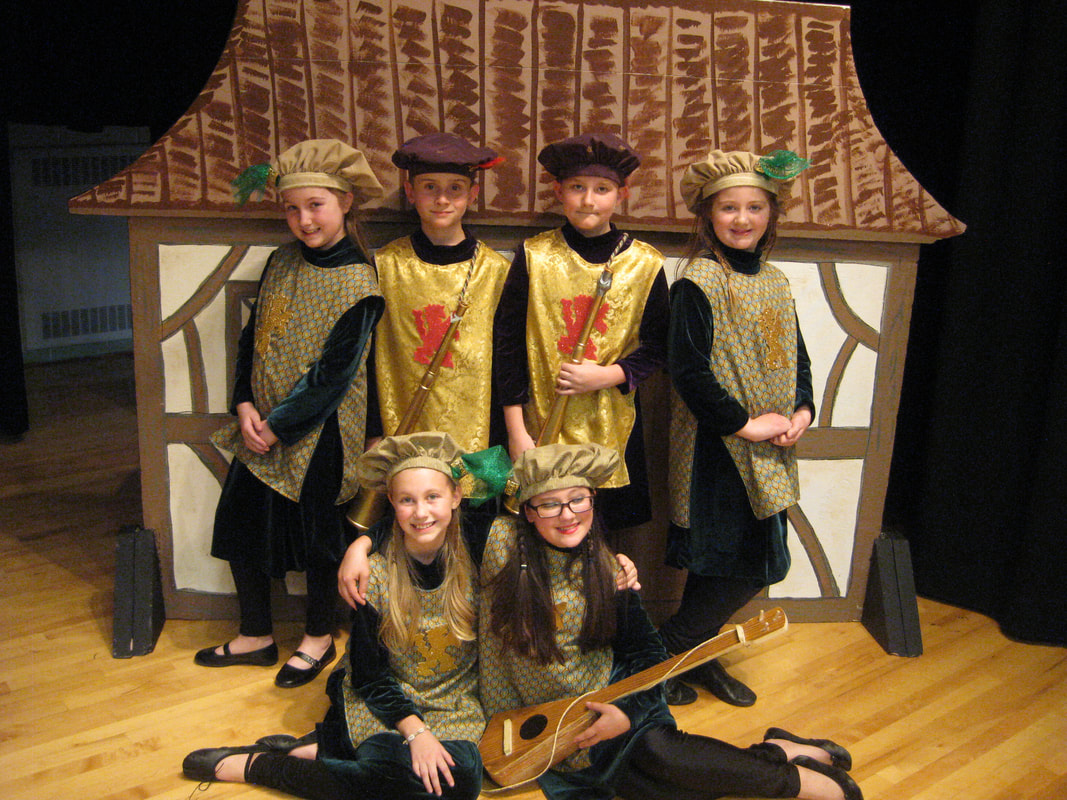
Old English Pantomime is a style of musical theater that I was not acquainted with until recently. And yet it has been in existence for more than 400 years! Stock players (the Everyman boy, the Love Interest girl, Comedy Duo, the Dame, the Henchman, the Do-Gooders), funny animals, slapstick comedy, sing-alongs, audience participation -- these are all part and parcel for this type of production. Until I did some research, I had no idea how fun this style of musical can be. Some years back, I had been asked to write a few songs for some books to help teach English to children in Asia. The publisher wanted to use authentic stories from English literature like "Chicken Licken," "The Little Red Hen," and a few others. One story was completely unfamiliar to me, "Dick Whittington and His Cat." The one little piece of information I had was that it was extremely popular at Christmas in England. In fact, it has been performed in London since 1605, at least. After doing some research, I found out that Dick Whittington was a real person who had been elected Lord Mayor of London two different times and that he may or may not have actually had a cat. However, the story (in various forms) was turned into a "panto" that has enjoyed popularity for more than 400 years. But why has "Whittington" been popular at Christmas all these years? Well, it is because Pantomime as a genre has been popular at Christmas for a family theatrical activity. Many different stories have been produced as pantomime since that time. The story of Dick Whittington has been a fun family-friendly favorite story and part of each season since 1605. "The Adventures of Dick Whittington" was premiered at Provost Elementary School and was hailed as an audience favorite show! The audience even sat on the edge of their seats ready to sing along when prompted. I think they really liked this experiment in Old English Pantomime. It even has an over-arching theme: LET KINDNESS BEGIN WITH ME. Comments from first audience: "This production was amazing! I have never seen a show at the Elementary School level done so well!" "We loved the show! The kids were super! It was great!" "I remember doing musicals 'way back when I was in Elementary school, but they were never anything like this! The show was so fun! I really liked it!" "I used to read that story to my children all the time. I just loved seeing it come to life for the students. It was colorful and delightful and I loved the songs!" Many years ago now, I was approached to write some songs for a collection of stories for an educational company that was teaching English to children in Asian countries. These stories were selected from some of the most famous folktales, fables and original tales from all over the world, but more particularly from England and Europe. One of the stories that caught my attention was "Dick Whittington and His Cat." I had never heard of it before and was enchanted by its charm. As I did some research into its origin and history, I was amazed by how it came to be. “Dick Whittington and His Cat” is a very old English tale presented first in Pantomime form in England about 1605. It is loosely based on the story of a real person Richard Whittington who was elected Lord Mayor of London three times, in 1397, 1406, and again in 1419. English Pantomime was a much-loved popular entertainment for families from the English Renaissance (roughly 1520-1620). Certain stock players were expected in English Pantomime --- the Every-man (a normal, likeable young man that things happen to), a Love Interest (usually a young, feisty, fair maiden), the Do-good characters (kind persons, fairy godmother, beneficent wealthy person), the Dame (an extremely fat, over–the-top character who has a garish taste in clothing and wears outlandish wigs and make-up — usually played by a man), the Villain (ruffian, bill collector, jealous witch, evil Rat King, etc.), a Comic Duo who provide slapstick comedy, and at least one Funny Animal. Audience participation in the way of cheering, hissing, and booing was encouraged, as well as a sing-along during or at the end of the performance. The great William Shakespeare himself used this framework for many of his comedies! The idea of using this recipe to create a Children's Musical piece was intriguing. I pondered my approach for a couple of years. I did research on some of the many versions of this play that have been produced over the years. Apparently, it has been popular, particularly at Christmas time, in England for over 400 years! In my research, I found that it is usually presented by adult actors to an audience that may include children. But there are many versions in storybook form for children. Curious. After more research, I found that Pantomime in England is traditionally done at Christmas time. It is considered family entertainment and any number of stories are presented -- usually folktales such as "Cinderella," "Robin Hood," "Jack and the Beanstalk", and many others. "Dick Whittington and His Cat" just happens to be one of the more popular stories. This show in two forms (for smaller and larger casts) has become quite a favorite. It actually works very well for child actors to perform. Using the stock players and framework of Old English Pantomime gives such a richness of history to this exciting Children's Musical. Enjoy The Adventures of Dick Whittington any time of year! In our community Chorale, we are preparing a Kaleidoscope of pieces from many eras. They cover quite a range from Renaissance to Modern day. Because I am currently writing a Children's Musical set in northern France in the 1500's, I am quite interested in the few Renaissance pieces. They have helped me get in the mood to write the needed courtly dances in a more authentic way. My sister who just retired from the Tabernacle Choir is very skilled at creating costumes. We met together last week to discuss how she might like to help me out, and she volunteered to create the costumes for my older actors (9-12 year olds). She also is well-versed in period-appropriate dress. And as an actress/singer herself, she knows just what will work on stage --- even with little people. I am getting excited to see what she comes up with. But back to the music. I have two plastic trumpet props. So, I decided to write parts for two Heralds. Their jobs will be very important --- they will introduce the show at the beginning and play fanfares at other transitions. Of course, they need appropriate music suitable to their official tasks. Fortunately, I have costumes I can use from a previous show. The Balladeers costumes from "The Adventures of Dick Whittington" will work for the two Herald Trumpeters as well as become basic pieces for some of the Knights. To the music again. I decided that as an Opener after the initial Trumpet Fanfare and welcome by the Heralds, we needed a Courtly Dance to get the Lords and Ladies onto the stage. And after singing some of these Renaissance chorals at Chorale and listening to some fun authentic instrumentals, I just have to do the Courtly dances in a minor mode resolving to major at the cadence.
This might be a little gutsy for a Children's Theater piece, but I just have to do it. Here's a sample from the Opener in "The Frog Prince." What was I doing this time a few years ago? Putting away a show, of course. It's fun for me to reread posts and relive good memories. From March 2016: So, getting all of the props and costumes and set pieces and extraneous stuff made, assembled, painted, sewed or otherwise collected and set up at the venue usually takes me the entire course of the run. And I do most of it by myself. But getting all of that stuff broken down and packed away after the last show usually happens very quickly thanks to a lot of useful helpers. This time, though, our last show of "The Adventures of Dick Whittington" was during the middle of the school day and not that many helpers were available. In other words, the few backstage helpers just had time to gather and box up the costumes. That left me alone to pack up my van to take things home at my leisure. It took me about a week to finally retrieve and transport all of the stuff back to my house. (Washing costumes, sorting, organizing and putting everything away may take another month!) My husband let me use his truck to haul away the last of the oversized items. I always tried to go over to the school during lunch times when I knew the door nearest the stage would be unlocked and the attendant teacher would be willing to hold it open for me as I hefted boxes outside. The last day, just as I was wondering how I would move the biggest props and set pieces, a bunch of 6th grade boys suddenly appeared.
"Can we help?" "Absolutely! You couldn't have come at a better time!" They were happy and energetic helpers. They made short work out of loading the bulky props into the truck and moving the large flat sets down to the storage tunnel. But, the payback for me was how excited they were to tell me how much they enjoyed the show. When they looked at the set pieces, they were quick to tell me that they remembered the scenes that they were used in. "I know what this is!" they would say. Then they would proceed to sing the song they recalled from that scene. "This is....There is too, too much to do! There is too, too much to do..." or "this is... Over the briny sea, boys! Over the briny sea!" They even tried to do the sailor's little jig! These boys had not been in the show, they had just come to watch it several days earlier when we performed for the student body. I frankly was surprised to find that kids seated 'way in the back of the gym were engaged enough to follow the action of the show, let alone to remember the songs! That really gave me a thrill. They not only remembered the words, but got pretty close to recalling the tunes, too! Kind of renews your faith in the rising generation, doesn't it? Last night I went to see the new movie "Wonka." I loved the "Willy Wonka and the Chocolate Factory" movie musical since it came out in 1971. I must have gone to the theater to see it 10 or more times that summer. (This was way before video or streaming.) I LOVED the songs and music by Leslie Bricusse. Hearing bits and pieces of the music from the first film reused in "Wonka" made my heart happy. I was especially pleased to hear them use almost all of the original song "Pure Imagination." That song was undoubtedly the most popular "stand alone" song from the first movie. It is often used in concerts and quoted in other situations. So, what would be classified as a "stand alone" song from a musical show? Well, first thing, songs are written for shows to fit a particular mood, to develop a character, or to move the plot along. They may work very well in the context of the show, but most would not be considered as concert material. After a time, though, some songs get a life of their own because the words and music can fit in other situations away from their places in the show. The songs in this new movie "Wonka" were clever, and were staged in engaging ways. However, it remains to be seen which, if any, songs will gain a life force of their own and become "stand alone" songs. Who can say what the fickle public will latch onto. One of the funniest points in the new "Wonka" movie was when the actor Hugh Grant sang and danced the "Oompa Loompa" song from the first movie (different lyrics) calling it the most catchy and annoying song and that he can't stop singing it. It is probably every composer's goal to write a score with at least one "stand alone" song in the mix. I know that has been a goal for me. Some people say that creating a "stand alone" song is just a matter of luck. It's probably much more than that, but I admit that luck must play a part. The composer's (and other collaborators') genius in recognizing and arranging the right elements of a song to fit just the right place in the storyline probably plays the biggest part. One of my scores I am particularly pleased with because it has a few "stand alone" songs. The children's musical "The Adventures of Dick Whittington" includes "Off to Seek My Fortune," "Over the Briny Sea," and "Let Kindness Begin with Me" that have been used in concerts and auditions and sung just for fun.
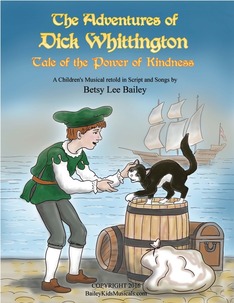
Several years ago now, I was approached to write some songs for a collection of stories for an education company that was teaching English to children in Asian countries. These stories were selected from some of the most famous folktales, fables and original tales from all over the world, but more particularly from England and Europe. One of the stories that caught my attention was "Dick Whittington and His Cat." I had never heard of it before and was entranced by its charm. As I did some research into its origin and history, I was amazed by how it came to be. "Dick Whittington and His Cat." is a very old English tale presented first in Pantomime form in England about 1605. It is loosely based on the story of a real person Richard Whittington who was elected Lord Mayor of London three times, in 1397, 1406, and again in 1419. English Pantomime was a much-loved popular entertainment for families from the English Renaissance (roughly 1520-1620). Certain stock players were expected in English Pantomime --- the Every-man (a normal, likeable young man that things happen to), a Love Interest (usually a young, feisty, fair maiden), the Do-good characters (kind persons, fairy godmother, beneficent wealthy person), the Dame (an extremely fat, over–the-top character who has a garish taste in clothing and wears outlandish wigs and make-up — usually played by a man), the Villain (ruffian, bill collector, jealous witch, evil Rat King, etc.), a Comic Duo who provide slapstick comedy, and at least one Funny Animal. Audience participation in the way of cheering, hissing, and booing was encouraged, as well as a sing-along during or at the end of the performance. The great William Shakespeare himself used this framework for many of his comedies! The idea of using this recipe to create a Children's Musical piece was intriguing. I pondered my approach for a couple of years. Then, I took two months writing it. Renamed The Adventures of Dick Whittington it went into production in January of 2016 and premiered in March. This was such a fun show to do! See pictures from it's production at Photos from Productions The Adventures of Dick Whittington 2016. I have done research on some of the many versions of this play that have been produced over the years. Apparently, it has been popular, particularly at Christmas time, in England for over 400 years! It has a pedigree that I had to respect. In my research, I never found it produced as a Children's Theater piece for child actors to perform, though. Mostly, it is presented by adult actors to an audience that may include children. But there are many versions in storybook form for children. Curious. Pantomime in England is traditionally done at Christmas time. It is considered family entertainment and any number of stories are presented -- usually folktales such as "Cinderella," "Robin Hood," "Jack and the Beanstalk", and many others. "Dick Whittington and His Cat" just happens to be one of the more popular stories. This song from the show has become quite popular for Elementary School concert programs. "Let Kindness Begin with Me" 2-Part Children's Chorus. Whenever I have looked around at prospective publishing sites, the hosts say "make a colorful cover" for your piece. So, I have spent some serious time learning to use Photoshop to create or fix my watercolor art. It has actually been quite a journey. Teaching this old dog new tricks has been difficult. I tend to get overwhelmed by technology. However, I can appreciate the many artists and techno-wizards that have made these powerful tools available to mere mortals.
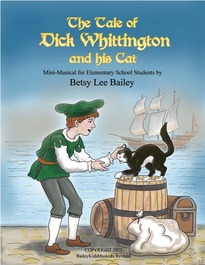
For mini-musical "The Tale of Dick Whittington and His Cat" I may have taken inspiration from looking at many, many children's book covers. I had known that this story had been around for centuries, but I had no idea that it had been made into so many children's picture books! That got me started, but I did my own work. Then I used the same artwork for the full-scale show as well, "The Adventures of Dick Whittington." And then I had to stop creating because something went wrong with my tablet and stylus. Told you I was overwhelmed by technology!!!!
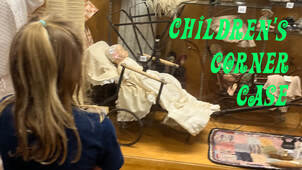
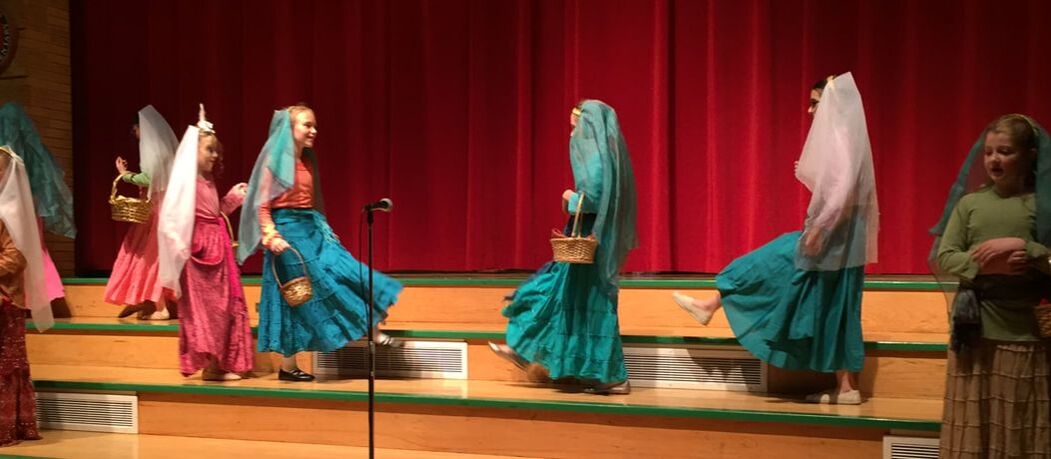
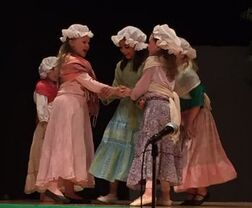
Once when I was seeking some guidance for an arrangement, a noted composer gave me this bit of advice. He said not to worry about revisions. Our compositions are called "pieces" because we may go back and fix different fragments any number of times. How true that is. I often go back and rewrite bits to better suit my performers. Sometimes I write in new characters and augment the story lines. Then I may feel that the new character needs his own song, and so forth. You just never know in Children's Theater who will come out for your show. Sometimes a talented kid appears out of the blue. Their abilities may trigger ideas that start the creative juices flowing. Once that happens, there is simply no turning back. New characters, new story lines, new scenes, new songs, or at the very least, new pieces of the music must be fixed. Then again, as a composer, you may have need to use bits and pieces of your music for other purposes. I was given an assignment to make short videos of exhibits in the Daughters of the Utah Pioneers Provo Pioneer Museum. The Museum Director knows a lot of interesting stories behind the various exhibits that other docents may not. So, I followed her around the museum catching snippets of her explanations. Sometimes knowledgeable docents are not present when visitors come. So, this is an effort to allow the museum to be enjoyed even if the visitor must observe the exhibits mostly on their own. These videos point out certain highlights to be sure not to miss. The other hope is that the English and Spanish transcripts may help visitors from other countries. They might even take a picture of the text with their phone and access Google Translate if they need a different language. My task was to edit the material into very short videos to put onto tablets so that the visitors can get a brief tour of exhibit highlights before they go off wandering on their own. The videos seemed like they needed musical underscoring for the title slides. So, I have used little 4 to 7 second bits of some of my Musical Theater and Choral pieces. Why not? I control the copyrights for these original pieces of music. So, we surely will not get into licensing disputes. This is one of the short videos we have created for the Tour Highlights of the Museum, the Children's Corner Case. The music comes from "The Adventures of Dick Whittington" and incorporates an Old English Nursery Rhyme "London Bridge is Falling Down." It seemed appropriate. When doing Children's Theater, planning choreography is very important. The movements do not need to be very advanced but they do need to be present. Nothing is more lack luster than LIVE Theater that looks dull and boring because it has no movement. I remember watching a movie musical recently where the ensemble really had just a couple of basic steps during one number. It's what they did to synchronize the walking and jumping that made all the difference. The groups walked several paces then jumped up all together on certain words of the song. It was the sudden lift of the jump that brought the choreography to life. Of course, the dancers swung their arms in a synchronized way and walked with measured steps, but that, combined with the jumps, was it. Well, as one of my choreographer friends used to say when you choreograph for Children's Theater, "These are children with basically no dance experience. All you can do is teach them variations in walking." So, what are the variations of walking she talked about? Walk, run, march, skip, slide, gallop.... And then you can always change the speed, direction, and intensity of the movements -- bend, lunge, lean, kick, point, hop, jump, twist, twirl, pivot, tip toe, sneak.... You can also vary the levels, planes and proximity of the dancers -- have different groups do different movements at different times in different spaces. Oh, yes, you can use arm positions and gestures, and my favorite, hand them a prop. An added challenge for choreography is space on the stage. Sometimes space is at a premium. For the show "The Adventures of Dick Whittington," one dance had to be performed in front of the curtain on the few riser steps. The girls could move in only two directions -- side to side. They could also turn in place. So their dance was fairly two dimensional, but still they had effective movements. Variations in walking -- I think there is a lot more to it than it sounds! |
AuthorMy name is Betsy Bailey. I have sung, written and taught music all of my life. I enjoy writing and directing Children's Theater shows. This blog will be directed to topics on creating the magic of Children's Theater. I would love to hear your comments! Archives
June 2026
|