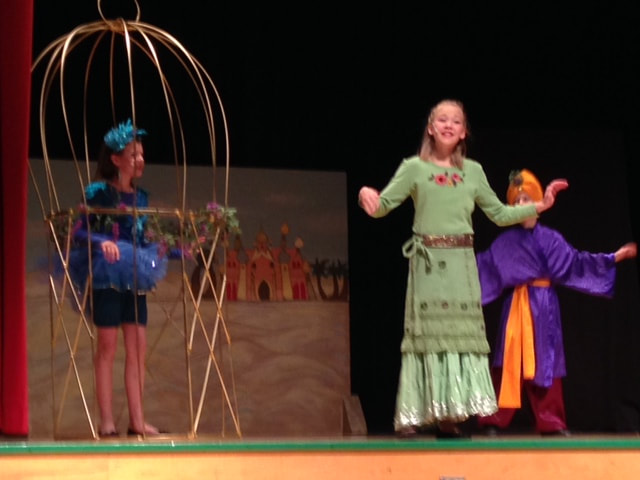
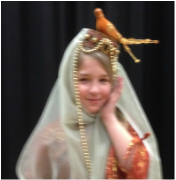
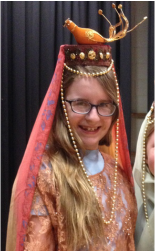
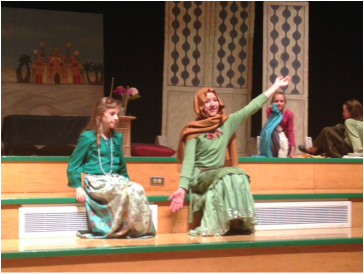
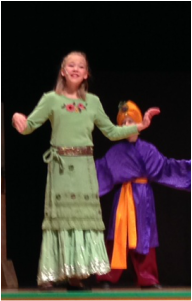
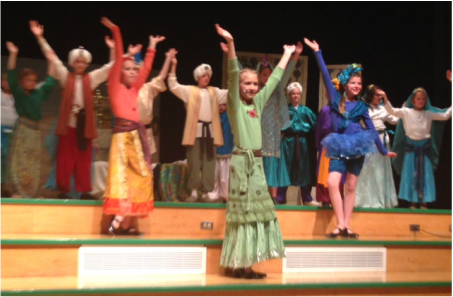
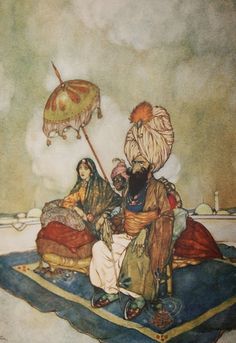
Cast of "The Adventures of Dick Whittington" 2016 But I sure miss those kids! They were great.
| BaileyKidsMusicals.com |
|
Cast of "The Adventures of Dick Whittington" 2016 Last night at my community choir rehearsal, my friend told me that her son had returned from his mission. That means that the little 4th grader who had been in some of my shows at his elementary school was grown up now, probably nearing age 21. What a talented kid. He brought to life some of the most complicated main characters I ever wrote. In fact all of those children who participated in the premiere performances of "Parizade's Quest" 2015 and "The Adventures of Dick Whittington" 2016 are all grown up and in college, on missions, working, or some are even married and starting families of their own. My how time does fly! I had first recognized Richard Stallard in the ensemble of "Never Cry Wolf" 2013. He stood out because he could sing, and move, and was willing to quickly do as directed. And he did things well. His brother had been in some earlier shows, and his sister came along later. All very talented. There were many kids in that school who were talented and willing to work. It was a joy to write new shows and unique characters for them. It is hard for me to believe now that these kids could handle sophisticated material including a lot of memorization, movement, sing well, and bring to life previously unknown characters. They allowed me to write (and edit on the spot) brand new material without any complaints. They indeed brought these shows to life. I am actually kind of sad that I removed myself from doing main stage shows for 4th-6th grades, drama club productions, and younger grade shows at that school. The building was going to go through a 2 year renovation (no stage), then my husband got sick, then COVID closed down everything. At the time, I just thought it best to "retire."
But I sure miss those kids! They were great.
0 Comments
One of the most interesting and consuming parts about writing a new play is creating and naming the new characters. In 2015, I was working on a new play for the upper Elementary Graders, 4th-6th (ages 10-12). The story that intrigued me was one from The Tales of the Arabian Nights. It appealed to me immediately for three important reasons. First, it is NOT a love story. (It is dangerous to have a love story or even anything close to a love story for this age range.) Second, it has plenty of the elements kids get excited about - magic, mystery and adventure. Third, it has the potential for providing meaningful characters for a large cast. Kids love portraying characters that have individual names and some sort of back stories. Who wouldn't? There is nothing very exciting about being Guard #6 or Servant #3 or Dancer #5. It is much more satisfying to portray a character with a name and a reason for being - at least for part of the time. I try very diligently to give each child a named character for their feature role and then have them fill additional Ensemble parts. This plan does not always work, but I continue to try. Why write for a just a generic Troupe of Gypsy entertainers, when you could create Barim who plays the guitar, Mona and Nadia who dance, Jamileh who tells fortunes, Ghalandar who does magic tricks, and Najid who has a trained dancing Bear named Bobak. For the premiere performance, I gave the children a little information concerning their characters and hoped that fed their interest to go on to fill out more of the BACKSTORIES for themselves. Where this story (in the translation I found) follows just a few main characters, a Children's Theater piece needs to be expanded to tell the story through dialogue and action and songs and dances involving many characters. That gave me the opportunity to create and name many new and unique characters. I love stories that come from exotic historical settings. There is such a richness in the cultures and languages of these places. And there is no richer or more colorful setting than that of Ancient Persia. The more I did research into ancient customs and architecture and designs and musical styles, the more exciting it became. And, for me, it was just plain fun to go through the lists of Ancient Persian names and their meanings to decide what fit each new character. That was when those characters became real to me. They suddenly got a life force of their own and I got inspired by the energy of their emerging personalities. Naming characters in a new play can be very exciting. You never know exactly how the characters will develop and shape the story or just how they will drive the plot along. I was delighted by how my young performers really inhabited those characters.
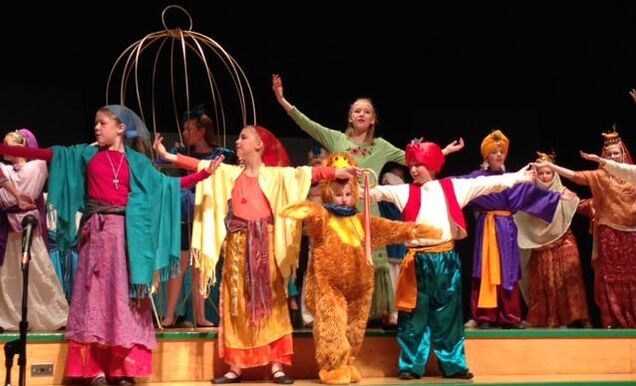
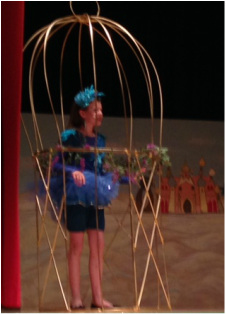
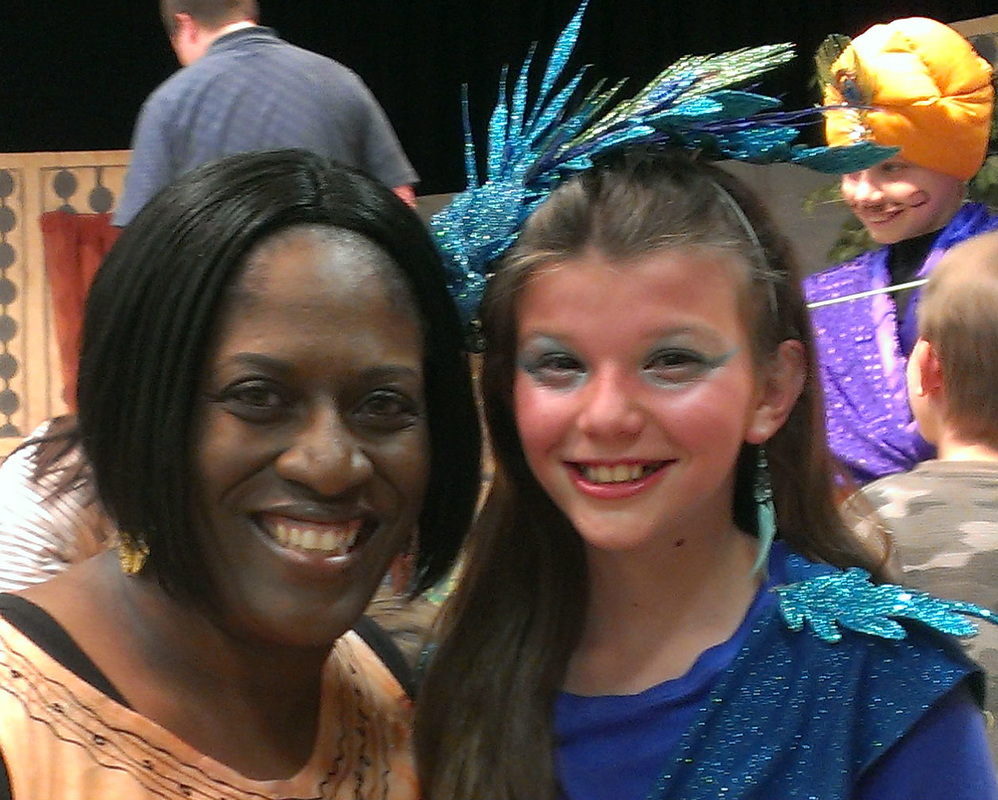
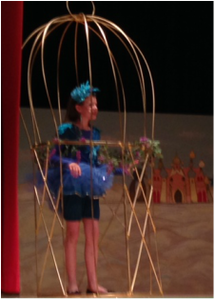
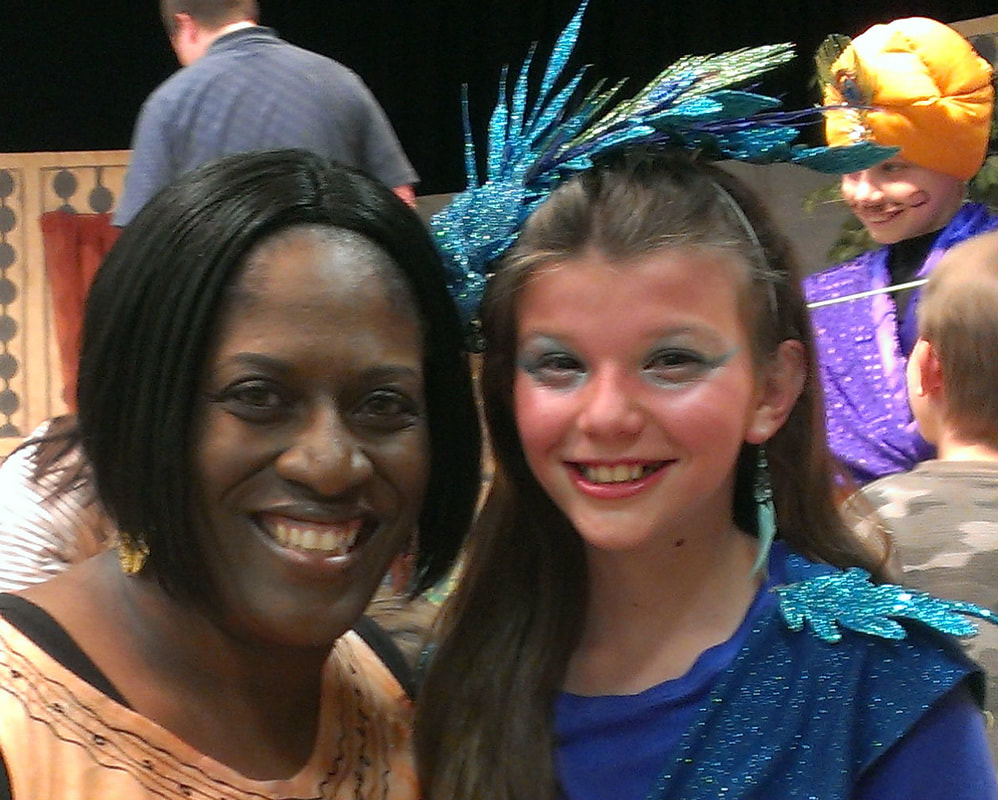
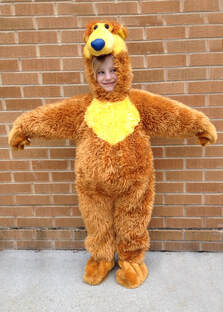
Comments from the audience: "THANK YOU for a wonderful experience for all those children involved. My daughter absolutely loved working with you on this." "THANK YOU! For all your hard work and dedication. I have to tell you that I was really impressed. The show was amazing. All the kids did so well. Such wonderful voices." "I always love having my kids work with you. Your musicals are so perfect for them." "You have sparked a real love of musical theater in my daughter. Thank you so much. She will most definitely be doing more singing and acting in her middle and high school years!" When writing for children's theater or books or any show that requires creating characters, making them memorable is always a worry. It is helpful to have some model to go by --- a friend, coworker, family member, example from theater, and so forth. But you have to be careful to make give them their own originality. Even a stock player needs some unique qualities. If, as a director, you are lucky, talented actors will show up for auditions and be able to imbue the characters with certain originality just by their own look, line delivery, and personality. Unfortunately, a writer has to give enough to the script to provide the actor something to work with. And then there's always the problem in Children's Theater with having many more females than males in the cast. It is wise to create the show with that in mind. Make sure the good parts are spread out with about a 2:1 female to male ratio. Always have great boy characters, but remember to make great girl characters, too! Here in 2024, I am in that situation again. I am trying to write a script for a new show "The Frog Prince" where I expect 20+ girls to 10+ boys in my cast. I know many of the children who will enroll in my summer camp, so I can almost pre-cast the show --- BUT I WON'T. However, it is useful to understand what talents and capabilities I will be working with. I know where to set the ranges for songs. I pretty much can guess how simple or challenging I can make the lyrics or dialogue. And I can visualize much of the costuming, blocking, scenery, and even choreography for the dances. This made me think of what I was going through nine years ago. In the winter of 2014-2015, I was writing a new musical. Just like now, I needed to find a show that could feature many female lead characters. Kerynne Vance helped me find a story and gave me other inspiration to model my characters after. She told me about the story of "The Speaking Bird." She said that it was a tale from the Arabian Nights stories that she had only just become aware of. She had been struck by the notion that it would make a great Children's Theater play or better yet, a musical. She liked the piece because it was not a romantic "love" story, but a reuniting of a family "love" story. Shazelle, the Speaking Bird in her birdcage When I read it, I liked it because it had great elements that make for good theater: mystery, comedy, magic, fantasy characters --- and a bonus for children's theater --- the opportunity for good roles for more than one GIRL. A beautiful "weeping" Queen, a "lost" princess, a clever storyteller, two jealous sisters, Gypsy dancers, and the magical Speaking Bird. This show became "Parizade's Quest." Creating a fantasy character that must be acted by a human can be a daunting task --- unless you have a great model for inspiration. One of my friends has a bigger than life persona and a rare and unique personality. I informed her frankly one day that I intended to model a character for my new play after her. And, in her inimitable fashion, she answered, "Absolutely! I have always thought that I would make a great character. You'll have to invite me to see the show!" So, with permission granted, I set off to give Shazelle, the Speaking Bird the funniest lines and the sassiest attitude possible! Thank you, Anne-Marie St. Felix! But, then there is the casting dilemma. As a director, you wonder if you will have a young actress come to audition with the talent and ability to pull off such a character. Fortunately, just such a girl showed up. Lizzie Jensen was perfect for the role. She summoned enough inner "sassy attitude" to play this over the top character and even learned how to do a tap dance routine for the Finale! Way to go, Lizzie! Here are the two of them together after the last show of "Parizade's Quest." And as Shazelle, herself, says in the play, "Girl, I am here to make sure the story is told right! I am the magic and mystery! Comedy, too!" And she really was! This wonderful fantasy character was a pure delight! "And trust me, honey! I am telling the absolute truth!" Bobak the Dancing Bear Unfortunately, sometimes you have costumes that are so specific that you have no choice but to find and cast an actor in the role who fits the costume. In "Parizade's Quest" there is a part for a dancing bear. One Halloween years ago, I stumbled upon the most darling bear costume at a thrift shop. I had always wanted a chance to use this costume in a show and when I wrote "Parizade's Quest," the opportunity arose. My had nephew spent a couple of years in Albania. He told me about how occasionally he would see strolling entertainers on the street and often they had a dancing bear as part of their troupe. That was it! I could have some street musicians with their dancing bear in my show! The school was to present this show with students only in 4th and 5th grades. But my Bear costume was very, very small. So in the end, we recruited the younger sister of one of the 5th graders to play the part. She was only in 1st grade at the time, but what a trouper. She did great, even though she could be in just a few scenes.
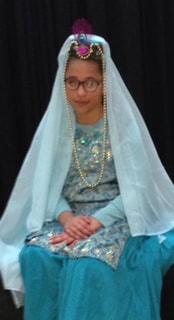
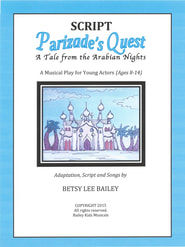
While I was visiting my daughter's family in the Seattle area, my 11-year-old grandson told us a situation that happened to him. (We thought this was humorous. He was not laughing.) He went to a combined activity with the youth at Church that did not suit his taste. They were doing LINE DANCING. That wasn't so bad. But then, they decided to have the kids learn some PARTNER dances like waltz and fox trot. My young grandson balked at that! Partner dancing requires actually touching the girl partner. YUCK! This is precisely why I never do Children's Theater shows that have anything close to a LOVE STORY. A few years ago I wrote a new musical for the 4th-6th graders at a local school. This blog post from 2014 tells a little about writing for 10-12 year olds. * * * * * * * * * * * * * * * * The story that has intrigued me is one from "The Tales of the 1001 Arabian Nights." It appealed to me immediately for three important reasons. First, it is NOT a love story. (It is dangerous to have a love story or even anything close to a love story for this age range.) Second, it has plenty of the elements kids get excited about - magic, mystery and adventure. Third, it has the potential for providing meaningful characters for a large cast. (Lead parts for 5 GIRLS! Very important!!!!!!) Kids love portraying characters that have individual names and some sort of back stories. Who wouldn't? There is nothing very exciting about being Guard #6, Servant #3 or Dancer #5. It is much more satisfying to portray a character with a name and a reason for being - at least for part of the time. I try very diligently to give each child a named character for their feature role and then have them fill in additional Ensemble parts. This plan does not always work, but I continue to try, nonetheless. Why write for a just a generic Troupe of Gypsy entertainers, when you could create Barim who plays the guitar, Mona and Nadia who dance, Jamileh who tells fortunes, Ghalandar who does magic tricks, and Najid who has a trained dancing Bear named Bobak. I give the children a little information concerning their characters and hope that feeds their interest to go on a fill out more of the BACKSTORY for themselves. Where this story, actually titled "The Story of the Speaking Bird" (in the translation I found) follows just a few main characters, a Children's Theater piece needs to be expanded to tell the story through dialogue, action, songs and dances involving many characters. That gives me the opportunity to create and name many new and unique characters. I love stories that come from exotic historical settings. There is such a richness in the cultures and languages of these places. And there is no richer or more colorful setting than that of Ancient Persia. The more I do research into ancient customs and architecture and designs and musical styles, the more exciting it becomes. And, for me, it is just plain fun to go through the lists of Ancient Persian names and their meanings to decide what fits each new character. That's when those characters become real to me. They suddenly get a life force of their own and I get inspired by the energy of their emerging personalities. * * * * * * * * * * * * * * * * "Parizade's Quest" is about re-uniting a family that had been torn apart. In that respect, I suppose this story has a LOVE element, but it is NOT a Romantic LOVE STORY. "Dress This House" is sung by Parizade (who doesn't know yet that she is the lost princess) as she instructs her servants to get her house ready for a visit from the Sultan. Kazhira, the Weeping Queen from "Parizade's Quest" Recently, I heard this line from my daughter as she was attempting to explain to her children some important events that happened previous to when they joined the family. She began, "In the time before remembering..." Now that line is every bit as good as "Once upon a time..." or "Long ago and far away..." don't you think? It sets the tone for a timeless tale. Don't know if it has been borrowed from some fantasy novel or not, but I intend to use it sometime, somewhere for some title. It is THAT good! Don't we all feel as we go through life, that we have forgotten key elements of our history. My teachers always told me that I should keep a journal of the important events in my day to day life. My problem was that as I was living those events, I couldn't tell if what I was going through was an important event or not. And then, after time went by, I didn't really remember the details of the events as I became aware that they were actually very important. Seems that only with hindsight do we discover the meaning we should attach to events in our day to day lives. And then those days truly become "the times before remembering." Fortunately, for me at least, I have family and friends who share enough of my life to help fill in the gaps when I forget details of the past. My sister has a good memory for people, places, and events and somehow remembers random facts from my life, too. And then, I tend to leave "breadcrumbs" strewn behind me. You know, the scribbles in notebooks or margins of papers that provide dates of past appointments, rehearsal times and locations, performances, etc. to help me remember what I was doing back then and when I did them. Eventually, when I get around to emptying out my purse, the excavations reveal a lot of archaeological evidences and clues to historical dates. If I was wise, I could make a record from those sources. I also do enough work on the computer to document many of the things I do and the computer furnishes a date for most of those activities. But, no matter the mixed-up details of my own life, the line "In the time before remembering..." seems to open up a timeless tale. At this time, however, I just don't remember what that tale might be. A song from "Parizade's Quest" comes to mind, though. It is sung by the weeping Queen Kazhira as she remembers the loss of her three beautiful babies. "By Morning's Light" is probably the saddest song I ever wrote for a Children's Musical. But it sets up the story of how a Family is reunited and all ends well. The Queen wishes she had something happy to remember. It is a time before her current reality, "in the time before remembering..."
And indeed it does. The storyteller Jamileh, the Beautiful Weeping Queen Kazhira, the two scheming sisters Beheshteh and Chaman Banoo, Parizade the lost Princess, and Shazelle the Speaking Bird. That adds up to six important roles - not counting the Court dancers, gypsies, and servants that are also female roles. Now don't get me wrong, there are plenty of good roles for boys, too: The Sultan Kashroo Shah, the Master storyteller Ghalandar, Old Torab, the two lost Princes Bahman and Perviz, the Gypsy musicians Barim and Najid, and Captain Rashid and the Royal Guards This story is so colorful and chocked full of magic and mystery. With a healthy costume and scenery budget, this play can be mounted in a most memorable way. The budget for our first production was not nearly enough to do everything I wanted to do. With a healthy budget, the costumes could be elegantly bejeweled and oh so dazzling! With access to a better stage, the sets could be so imaginative and spectacular. There could also be some magical effects with lighting and puffs of smoke. Oh well, maybe those special things will happen in a later production... "How's that video coming along?" was the question on many a person's mind during the entire month of April and most of May. The reality was that even though I had graciously received donated video footage from three different performances and the dress rehearsal of "Parizade's Quest," I really did not have the software or the knowledge to do anything with it. As I was researching how to proceed, I discovered that I needed first to convert the contents of the seven DVD's into a program that my computer recognized. During that process, my computer crashed. Apparently, the conversion software I downloaded from the internet contained malware. So, my computer got to spend a week in the shop waiting to be repaired. Before I got the computer back, I took a trip to visit grandkids in Pennsylvania for another week. Once home again, I was able to retrieve the computer. AND -- I also signed up for lessons to actually learn video editing. In the first lesson, I learned some of the beginning steps to edit a video. I was to go home and practice those new skills. I quickly found out that I truly did not want to start at the bottom rung of the ladder! I wanted to instantly be able to do what my director's eye wanted to see happen. The biggest problem was that I needed to learn a boat load of new vocabulary in order to work the software. Back to the shop for Lesson Number 2. Okay, this lesson was enlightening and gave me some courage that I could do what needed to be done. So, still with trepidation, and a looming deadline, I marched back home to get the job done. A week of soaking rain storms made my office in the basement seem like a dark dungeon. In spite of dampening skies and my ever dampening mood, I kept on keeping on! There were so many problems with the footage that made the vast majority of it unusable. One night, the camera was positioned behind a man with a bald head who kept reaching up to take pictures with his arms way high or reaching to scratch his head sores. Eeeeoooh! So gross! Another night, the camera was located to the side of the hall at a very acute angle. Much of that show's footage was usable, but the show had other unfortunate malfunctions. The last show had the best camera angle from a tall height, and it was by far the best show performance-wise, but the camera was located so far to the back of the hall that it picked up incredible audience noise -- babies crying hysterically, loud rustling and coughing, and the creaking and moaning of constant walking on an ancient gym floor! I tried to patiently go through all of the footage one scene at a time, comparing all of the takes, hoping to find bits of good performances that could be spliced together. Well, one thing is certain, I certainly learned a lot in the process. What an agonizing process! Just in the nick of time, and I am sure with some divine intervention, I got 25 copies of the keepsake DVD made for the cast members and their families -- packaged and delivered to the school. I hope the kids enjoy seeing their show! Whew! Antagonist...villain....comic relief...yeah, the supporting actors. Where would the story be without these important roles? Where's the mystery, suspense, and comedy? The plot of a story is mostly served through the doings of the supporting players. It is all well and good to have fine lead players, but without equally good supporting characters, they would have nothing to play off to make them look so good. Too bad that supporting characters and villains get such a bad rap in children's theater. Without them, the heroes and heroines would not shine. The contrasts between the character traits and individual choices of the protagonists and the antagonists are what make live children's theater so meaningful and instructive. My goals have been to share stories where good triumphs over evil, where love conquers all, and hope springs eternal. Yes, these goals may seem old fashioned, but they are eternal truths and must be championed, especially for impressionable youth. And yet, how can good overcome evil if that choice is not offered in the first place? Hence the need for the villain. In thinking about casting a nefarious character, my heart is often troubled. Whoever is cast must be of sufficient self esteem to realize that I am casting them strictly by their acting abilities and not because I think they have evil traits. Fortunately, a pair of just such actresses were available for the roles of Beheshteh and Chaman Banoo, the jealous sisters of the Queen, in "Parizade's Quest." These girls needed to portray jealousy, cunning and craftiness with a hint of comedy during the course of the play. The audience need not have any sympathies with them for their evil deeds. In fact, in the end, their banishment should prove to be satisfying to all. And yes, I was glad they got a nice ovation for their hard work during the bows. They gave wonderful performances. So kudos to Kaylin Wilson and Candace Taylor for being such great Supporting Actresses! You both did a great job! In my experience with Children's Theater casting calls, the overwhelming majority of applicants are females. Also in my experience, these talented and often-times well-trained dancer/singer/actresses are vying for the same one or two prominent roles in the play. How heart-breaking it is, also, when the pretty little girls are asked to play male lead roles because not enough boys showed up for auditions or because there simply were not enough good roles for girls in that production. Knowing this predicament, I have constantly been on the lookout for stories that could be adapted to feature five or more strong female leads in important roles. "Parizade's Quest" is just such a story. The play opens with a story teller (female) reciting her story to a master storyteller (male). He gives her some pointers and tells her he would like her to start over again but this time they will try out the story on "these good people here" (audience). The audience dutifully applauds to give encouragement, and Jamileh begins again. Master Ghalandar promises to be with her and lend support throughout the retelling. In fact he, he inserts more than Jamileh actually expects -- "Why not, it is an unexpected twist. You want to lead the audience on adventures in the mind and just when they think they know what to expect --- you surprise them!" The character of Jamileh, the storyteller, however, goes on to control the entire story including jumping in to play other characters to move the plot along. The actress for this part needed many skills, not to mention having a great memory. Because she was included in nearly every scene, she had no choice but to have the entire show memorized. Fortunately, just such a talent appeared for auditions. Ellie Geslison gave a stellar performance as Jamileh, the storyteller, the Gypsy dancer and fortune teller, the Old Woman, and was the glue that held the whole production together. She is quite the triple threat -- a beautiful singer, actress and dancer and she even learned some tap dancing (new skill) in order to do the Finale. Kudos to Ellie for her talent and grace. Thanks for lending such elegance to this premier performance of "Parizade's Quest!" |
AuthorMy name is Betsy Bailey. I have sung, written and taught music all of my life. I enjoy writing and directing Children's Theater shows. This blog will be directed to topics on creating the magic of Children's Theater. I would love to hear your comments! Archives
July 2026
|