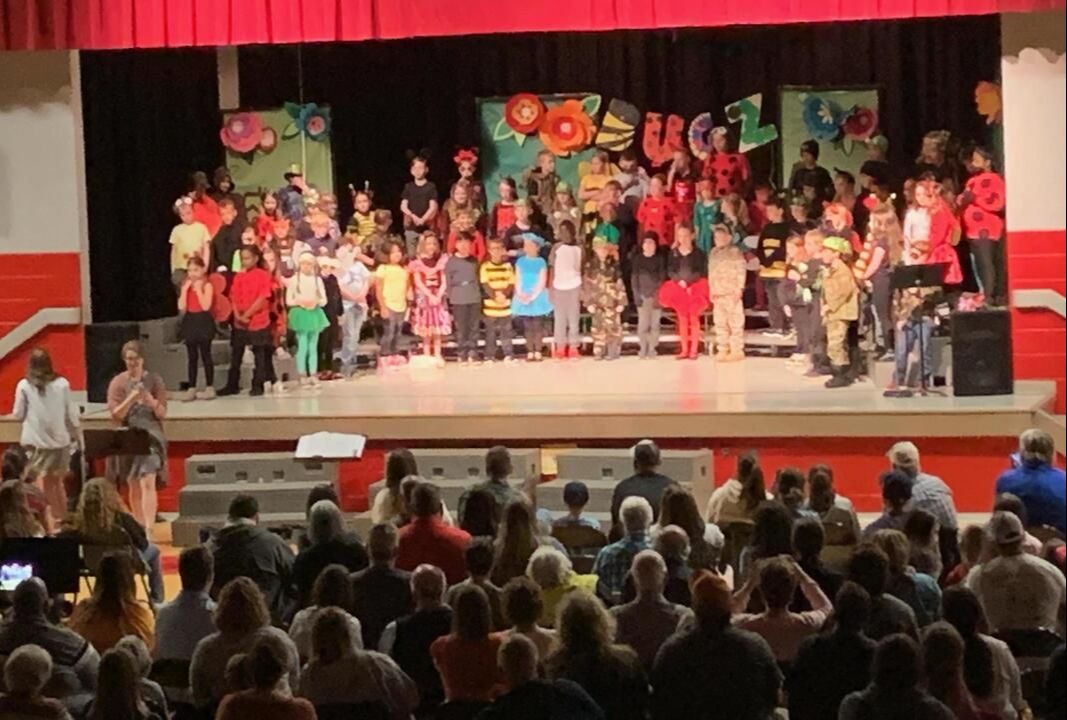
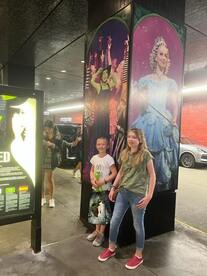
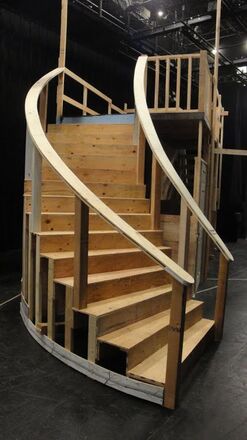
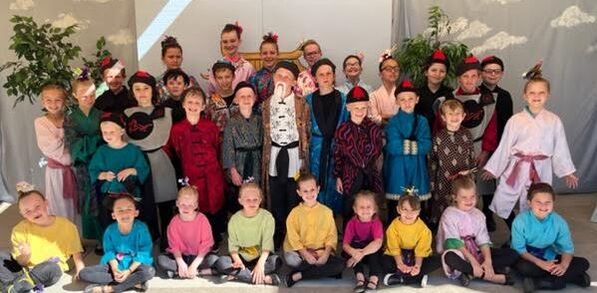
These pictures come from a performance of "Momotaro" a Tale of Bravery at the Sego Lily Elementary School in Lehi, Utah. A very talented photographer snapped these pics.
| BaileyKidsMusicals.com |
|
|
You have all heard of Choreography, of course. But "Choral"-ography is something a bit different. It is coordinated, but limited, movement for a chorus of singers. Sometimes it t is just a synchronized gesture or turn of the heads, other times actual full-bodied movement. The key is to make the movements fit the words of the song and not be too boisterous as to confuse the singers or hamper their singing. Many Chorus teachers will use gestures to help teach a song to young students. Teaching a song with hand motions or even modified sign language can be helpful tools. However, when blocking a large Ensemble of children on a stage in a show, doing CHORAL-OGRAPHY is better. The gestures and body positions must "read" from a fair distance, so they need to be large and coordinated to be seen from the last row of the audience When composing a song for an ensemble of young children, I try to think about it in terms of choral-ography. In other words, I always try to imagine how the children would interpret the song on stage. The words come across best when simple gestures can be used to emphasize the meaning. Words suggesting a direction such as "up" or "down" I make sure have a gesture or body movement to emphasize that. Lyrics about joy or love or happiness might have a gesture of clasping hands at the heart. Lyrics about sadness might use slumped shoulders and frowning faces. Words with abstract meanings are the most difficult to interpret. I usually save the simple generic hand and arm motions for those lyrics --- arm out left, arm out right, both arms up, one arm up in back and one down front with "jazz" hands (fingers wiggling), etc. First-time actors are generally not trained dancers. So only very simple foot movements can be used. Variations of walking, sliding, or spinning are about the extent of full body motion that can be safely used. Kids usually have trouble with Right and Left and other stage directions, so I try to remember to keep it consistent by always starting on the same foot or turning in the same direction with succeeding passages. It is crucial that when you begin teaching choreography of any kind, you continue practicing what you started. Making a lot of changes just confuses them and they don't know what to remember. Most kids tend to remember the movements you taught them first. So figure it all out before you get started. With enough practice time, it is surprising how proficient kids can get at their movements. And remember that if you work in front of the group facing them, you must "mirror" their motions. If you use your right hand, expect them to use their left hand. Be prepared to reverse that if you turn around to face the same direction as the group. Using "Choral"-ography is a great way to have your group interpret the songs and give a polished performance! These pictures come from a performance of "Momotaro" a Tale of Bravery at the Sego Lily Elementary School in Lehi, Utah. A very talented photographer snapped these pics.
0 Comments
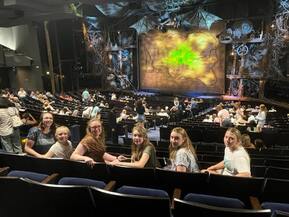
For my sister's birthday a few nights ago, we other sisters took her to see a musical at a new theater in the area. This venue had a very small stage that projected out from a small proscenium. The seats for the audience were placed so that they went up from the small stage on three sides. The action was blocked to take advantage of playing to all three side of the audience, almost theater-in-the-round. This production was staged in a way that as an audience member you thought that there were no bad seats in the house. The scenes, songs and dances were "played" to every vantage point of the audience. Even though we sat halfway up on extreme stage left, we could see all of the action and were well-entertained. I knew next to nothing about the show before we came, just that it had something to do with Shakespeare. The stage was decorated in Elizabethan style, and when the minstrel came out in his elegant Renaissance costume and beautiful lute in the opener, I realized that the rest of the production would be costumed to the hilt. Apparently, this production was just as polished as the show on Broadway. The acting, singing, and dancing were very well done. I loved how the actors in this show were all triple-threats. They had fabulous voices, great stage presence, and could even tap dance. (Quite a surprise for a show set in the 16th century in England.) I found myself enjoying this show as much or more than any show I've seen on Broadway. What show you ask? "Something Rotten." written in 2015 by Karey and Wayne Kirkpatrick, and John O'Farrell. It struck me, though, that the reason I found it so funny was that the musical quotes not only Shakespeare, but nearly every famous musical produced on Broadway. So, in order for an audience member to really understand it, they must have at least some knowledge of famous quotes by Shakespeare as well as know a lot of songs from Broadway musicals. Fortunately, I am one of those who fits that profile. And I was in good company on the opening night of this production. "Something Rotten" at the new Ruth Theater in Orem Utah is delightful! Last night, the community chorale I sing with was invited to sing in the "Dancing with the Stars" Utah Extravaganza. It was a big variety show held at the UCCU Center on the UVU Campus. (That's the big basketball arena.) We performed with the UVU symphonic orchestra plus two community orchestras, three community choirs, six amazing vocal soloists, back-up dancers, and the headliner dancers from LA, Val Chmerkovskiy and Jenna Johnson (Champions on "Dancing with the Stars." We didn't have much time to practice and didn't get much information about what to expect other than we were singing the chorus parts to a few Broadway numbers like "Tradition" and "Sunrise, Sunset" from The Fiddler on the Roof with marvelous local actor Daniel Hess. It turned out quite fun. Dallyn Vail Bayles took down the house with his numbers "Bring Him Home" from Les Miserables, the David Foster duet "The Prayer" with Amy Keeler, and "To Dream the Impossible Dream" from The Man from La Mancha.
The show was produced by Nate Keller and 90-year-old icon Carl Bacon. I remember Carl Bacon from when my Aunt Janie Thompson did many big shows at BYU with him (the precursor shows to The Stadium of Fire). Despite his advanced age, it made a lot of sense as we learned that there were a lot of his grand and great-grand children in the cast. The orchestra was huge! The conductor Dr. Cheung Chau is incredible not only as a conductor but as a cello soloist. His wife, Dr. Blanka Bednarz is a fantastic solo violinist as well as the conductor of the Utah Valley Youth Orchestra that was also part of the show. The evening was packed with a lot of talent and very entertaining. This evening caused me to ponder on the significance of having opportunities in the community for people to participate in good orchestras and community choirs and occasionally get to do something big. I have lived in many places where people wanted to be in performing groups, but had no groups to perform with. Utah Country, with two big universities and many feeder music programs in the high schools, and local community orchestras and choirs plus some top-notched dance studios seems absolutely saturated with opportunities for talented people. And there are motivated producers that make performance opportunities possible. On a less lofty note, for this Easter, even our Stake and the neighboring Stake, have combined to put together a 40 piece orchestra and a 75 voice choir to sing a concert on Good Friday. It truly is amazing to have so much talent around here! So, stage presence is something you've either got or not, right? Well, some people seem to conquer stage fright easier than others, but I maintain that everybody can learn to be more comfortable in front of an audience. Years ago, I was responsible for the Primary Presentations in my ward. That is a program done yearly by the children ages 3-11 at Church. Their teachers and leaders help them learn songs and lines to say that present what they've been learning to their parents and others in the Ward. The Primary Presidency and the Music Leaders work together to come up with the ideas they should present and work towards this presentation throughout the year. I am something of a connoisseur of Primary Presentations. I have gone to so very many over the years due to having 7 children and nearly 27 grandchildren. I have also worked in Primary for 43 years where I taught the music for most of that time. Let's just say that I have done my share of attending as well as writing and directing these programs. In the olden days, the Church headquarters sent out the exact program to follow. It included all of the songs, the spoken parts, and even suggestions for "staging." Some parts had a variety of options the director could use such as choral readings, group discussion, solo or small group songs, using instruments, visual aids, etc. Some of these presentations were rather elaborate. They really only worked for Wards with large Primaries that were loaded with talent. Now, the Primaries throughout the world are responsible for writing their own presentations while following just a few suggestions from Church headquarters. The toughest part of doing these presentations is always the same: how to get the children to speak and sing their parts in an engaging way so the parents and others can understand them.
Unfortunately, not all leaders understand how to REHEARSE EFFECTIVELY to help the children learn their songs and lines, to enunciate clearly, to stand with poise and posture, and to never leave the microphone until after they finish their part. That's when having some training in stage production comes in handy. I will never forget back when I was then a Primary President and an older lady sought me out to ask me the date of our Primary Presentation. She wanted to know so SHE COULD MISS IT! I vowed from that moment on that all my Primary Presentations would be rehearsed enough so that even the shyest kid could be understood by the nearly deaf 92-year-old sitting on the back row! Just got back from visiting my daughter's family in Washington state to watch her in a production of Rodgers and Hammersteins "Cinderella." She played the stepmother. I have to admit, she was very strikingly glamorous on stage with a very commanding stage presence. Whenever Carolyn did something in a scene, she stole the focus. It's a good thing that she was so enjoyable to watch! This is the first role she had played since her days in High School. At least a role she actually auditioned for and practiced. She has had to fill in for sick or injured actors in some shows recently where her job was really as the choreographer. I may be biased as her mother, but I was so proud of her! The audience seemed to think so, too, because she got the longest ovation. This production used the "Enchanted Version" script of "Cinderella." (Apparently there are five separate scripts of this show.) (SRO) Standing Room Only community theater production of "Cinderella" Also in the show were her daughter Lucy (child above center in pink), her son Fisher running the spotlight, and her husband's brother and his entire family. The Cornwall clan played roles such as the Prince, the King, and a Mouse/Villager as well helping with stage managing, sound board, and doing the musical directing. Previously, Kelly (musical director/accompanist) and Carolyn (choreographer) were busy every year supporting the High School Drama Club putting on the High School Musical. Because of the failure of a levy in their school district for funding, their jobs were cut. Jobs in Music, Art, and Drama in the school district are no longer available. So sad!
So brave Kelly and Carolyn are brainstorming ideas to bring attention to this problem in the community as well as getting some funding to support choirs and bands at least at the high school level this year. One way is doing some benefit concerts as well as supporting the local community theater. Wish them well! This is the time of year when directors and teachers get to experience regret or validation in what they have chosen for performances during this new season or school year. Most of the time, they must acquire materials looking ahead only guessing at what their group will be suited to or will gravitate toward and hope that they have chosen well during the summer. Kyoko and Animal Warriors from "Momotaro" As a director, you may think you know the talents of the students who will take part in your groups, but you don't always know for sure. Then again, you may be surprised at new talents or sudden development of latent talents as they appear in the students. This situation is what can cause ulcers, for sure. Many teachers/directors will do the same few shows over and over again, for good reasons: Number 1 - They have done it before, so it is a known quantity. They may already own a lot of the costumes, props and scenery, too. Number 2 - The lead parts are few, so the acting/staging/rehearsing is simplified. The Ensemble can absorb any and all other students that only have to be taught the songs to sing plus a few dance numbers. Number 3 - Many schools or children's theater companies have very limited budgets, so they must compromise on acquiring new or expensive materials, or hiring extra helpers. Well funded groups that have adequate rehearsal time and space as well as talented staff can work to maintain momentum through successive seasons. They may even plan several show runs throughout an entire year. Smart Drama teachers will coordinate with their Music counterparts and plan their School Musical for the next year and ADVERTISE it well before the end of the previous school year. Other groups/teachers are not so fortunate. My hope is that some brave directors/teachers will take a look at other options as they plan their new seasons. It is good to choose vehicles that can give more than just a few students featured roles and keep more kids busy with meaningful parts throughout the entire show. Take a chance on new works that may be a challenge, but are so worthwhile. Here are a few suggestions of Main Stage Musicals for 4th-6th Graders: "The Adventures of Dick Whittington" - interesting historic setting, old English Pantomime characters, fun music and dancing "Never Cry Wolf" - Aesop fable, ancient Greek setting, story within a story, music from many styles "Parazade's Quest" - Tale from the 1001 Arabian Nights, opportunities for five female leads and as many males, action, drama, and suspense Here are a few suggestions of Main Stage Musicals for 2nd-3rd Graders:
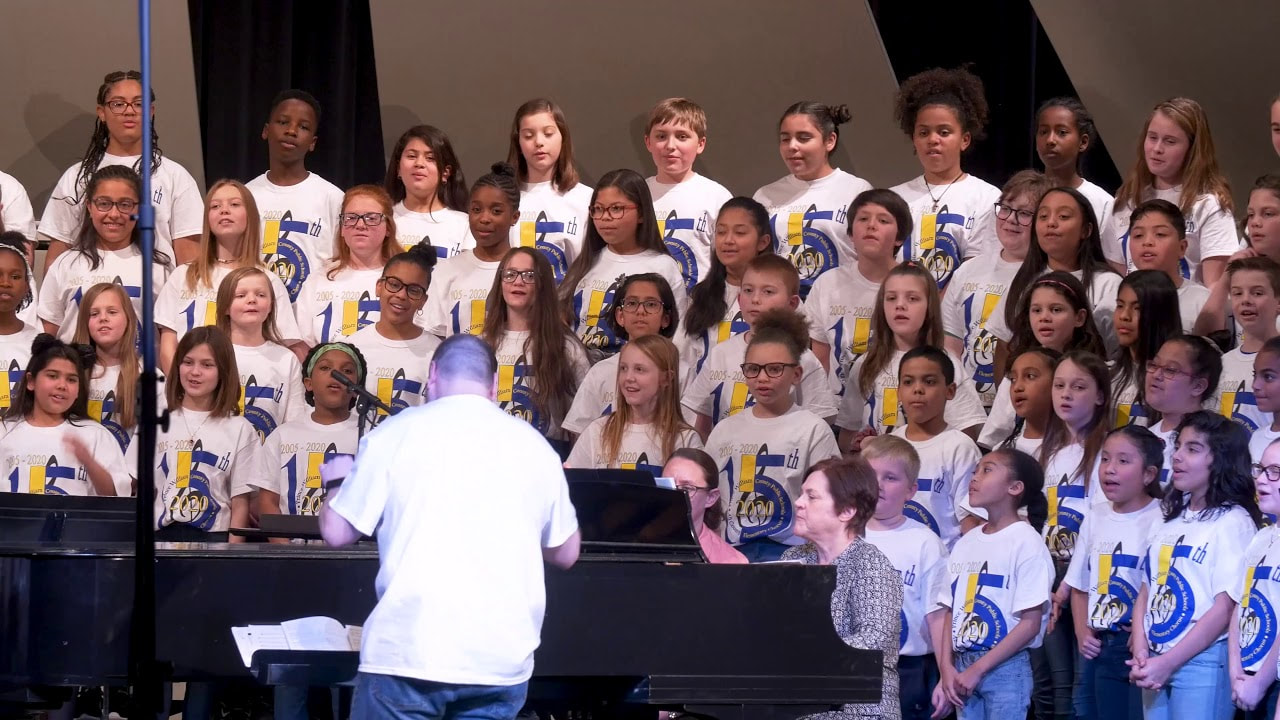
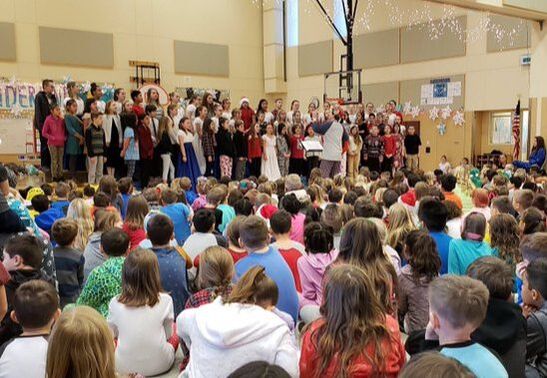
"The Tale of Chicken Licken" - Comedic parts for many characters, easily separated into rehearsal units, irresistible costume opportunities "The Frog Prince" - familiar story without the love interest, parts for many princesses, and plenty of comedy and action for the Knights "Momotaro" - a beautiful retelling of a Japanese folktale using Kabuki theater stylizations, colorful costume and dance opportunities The first ever performance of "The Frog Prince" went very well yesterday. We had a very responsive audience that really got into the show. They laughed and clapped, and "Ooh-ed and Ahh-ed" in all the right places. The singing was heartfelt and the acting was hammed up where it needed to be. And of course, there was plenty of cute factor from our littlest people. My crew started setting up shade canopies and the 30+ chairs I have during the 9:00 am hour. Other audience people kept arriving with their own chairs until 10:00 am and beyond. That's when the show was supposed to start, but people kept coming and coming. So I gave the audience a pep talk to give them a little more time to get settled. I didn't really count, but there must have been close to 200 people trying to get a spot where they could see the stage. My backyard is pretty wide, but it isn't really wide enough for that many people! At 9:30 am, before most of the people were in their seats, we attempted to get a cast photo. The sun was low enough still that the kids wouldn't open their eyes and smile. We took a few shots anyway -- at least for history's sake. "The Frog Prince" Summer Camp Show 2024 It's gratifying for me to hear the comments from the audience after the show. Older man: "There were so many surprises! The part with the puppets was brilliant. I really enjoyed the show!" A Grandmother: "You had so many good singers in this cast. It's amazing that you can get so much out of these young kids in such a short time." Man: "We loved being able to root for the Knights during their battle scene!" Woman: "The little princesses were adorable!" Older woman: "I was so glad that this show had such a good message. So many kids' shows these days seem pretty dumb and the music isn't very good. I loved how the songs were so singable! I think we'll go home singing them!" Now, I just have to pack everything away. Whew! The last few weeks I have been studying videos of 4-5th Grade Chorus concerts. My interest has centered on concert shows that have a coordinated THEME or have been written by one composer. Some shows have focused on curriculum-driven topics such as The Westward Expansion, or Ancient Egypt. Some have been just for fun like 1950's Rock 'n Roll or Under the Sea, or Jungle Safari. As I watched the videos of just regular school groups performing, I noticed that the best performances were when the singers sang with SIMPLE LIVE accompaniment. In other words, the chorus sounded best when they were not overshadowed by SOPHISTICATED full orchestral accompaniment minus tracks. When the children were supported by just a few live instruments (piano, flute, bass, guitar, etc.), they tended to sing better IN TUNE and with more musicality and cohesion. Sure, the highly orchestrated minus tracks were flashy and fun, but they were difficult to balance with the singers in a live setting without the benefit of good SOUND EQUIPMENT, good ROOM ACOUSTICS, and most of all, a good SOUND ENGINEER. Then, when the accompaniment was boosted high enough so that the singers could follow it, the singers themselves were overwhelmed. But if the music was not boosted, the singers had trouble staying in tune. A vicious cycle. ROOM ACOUSTICS are such a determining factor for whether a performance will be successful. Let's be real. Neither a gym or cafetorium were designed for musical performances, yet they are the only venues available at most schools for performances. They have no carpeting or acoustic tiles on the walls to limit ECHO. They may have huge AC fans or Heating vents blowing very loudly -- of course during the performance! The only speakers may be of the "Dixie cup" order imbedded all over the ceiling. The Minus tracks will be broadcast through these little speakers, but the chorus won't. Balance may be impossible to achieve. Most of these shows could have been staged as and considered concert-style Musical Theater. The STORY LINES and NARRATIONS were well-conceived, just difficult to manage given the limitations of the venues as well as the limited vision of the Director. The movement of kids climbing on and off off the risers to get to the standing microphones took a lot of time, was rather noisy, and looked very distracting. And the epic, grand orchestrations were simply too sophisticated for the situation and were awkward to CUE. The kids tended to try to match the volume and style of accompaniment. But instead of sounding like beautiful singing, they ended up sounding like a lot of unmusical shouting. By contrast, the chorus concerts with piano accompaniment, even in a less than optimal hall, had much better balance. The piano was truly FOLLOWING and SUPPORTING the singers --- NOT the other way around. Yet, even when some of the groups had to use a recorded accompaniment, the SIMPLE (fewer instruments) tracks balanced the singers better.
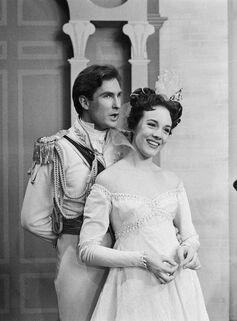
Too bad so many chorus teachers chose the more SOPHISTICATED minus tracks for their concert programs. The other night our television was on the fritz, so I decided to watch a movie on my phone. One of the choices that popped up was Rodgers and Hammerstein's 1957 version of "Cinderella." I was curious because last summer I went to see a less than satisfactory production of "Cinderella," and I wanted to compare scripts. "Cinderella" has been told and retold in so many ways for so many years that who knows what the original story truly was. All I know is that I expected particular Rodgers and Hammerstein songs and a story that included a girl that has been reduced to being a servant in her own home, a wicked step-mother, two awful step sisters, a handsome prince who is hosting a ball, a fairy godmother, some magic, and two glass slippers. What I got last summer was some of the stuff on that list, but also a lot of extraneous stuff that made the story more complicated and politically charged than it needed to be. The 1957 made for TV production was very different from what I expected, but it did keep most of the elements on that list. The 1957 "Cinderella" was made directly for television. It starred Julie Andrews (who was currently in a little Broadway show that was another "Cinderella" story: "My Fair Lady"). And although the Julie Andrews "Cinderella" was produced for television, it looked like they just filmed a stage show with some interesting camera angles. The sound stage had one basic set that was turned different ways and dressed different ways to represent different scenes. That's how a stage production would be produced. And for early television, the show was in black and white. Possibly, it was presented live, I don't know for sure. Television was a new medium in those days. I think the producers and directors didn't know exactly how to present this show for the small screen. Apparently, they opted for keeping things simple. They kept all of the scenes confined to a single sound stage. There were no sweeping outdoor vistas. There were barely any full crowd scenes. Most of the camera angles framed just a few of actors. There were some changes in camera angles such as from the top of the stairs looking down, or from the bottom of the staircase looking up. The most dramatic camera work happened showing the trying on of the glass slipper to "all" of the eligible maidens in the land with one short clip following another short clip, then another, then another in very quick succession. The script was very different from the show I saw last summer. It was very different from the other versions of the Rodgers and Hammerstein "Cinderella" that I have seen before. In fact, every version that I've seen has been quite unique. Each separate production even borrowed extra songs from other Rodgers and Hammerstein shows, and not the same ones from the previous show. I am beginning to think that there may be several different licensed scripts for "Cinderella." And then again, live theater has a reputation of of allowing a certain amount of "artistic" license for interpretation. I'm just glad that some big improvements have been made in how theater is presented on television. I think I like movies, or live theater, but not stage shows filmed for television. Ringing in the New Year with Dinner and a Show. My sisters and nephew and niece invited me to go with them to a New Year's Eve production of "Pride and Prejudice" at a local community theater. Apparently, the Hale Center Theater Orem does this type of production every New Year's Eve. They host a catered dinner at 9:00 pm where the patrons eat at their seats. Then they start the show at 10:00 pm. Dessert is served at intermission. They break for the ringing in of the New year at 12:00 midnight no matter what point they are in the show. This theater company has a tiny, tiny stage. The limited audience is seated very close to the stage and see the show "in the round." So whatever play or musical this group mounts cannot rely on fancy sets or props or even a very big cast. There simply is not enough room for many bodies, bulky costumes, intricate sets, or a lot of props. From what I noticed, the only set decorations were some white mirror frames hanging high in the rafters. The set pieces were some elegant dining room chairs, one small round table, and a small "box" spinet (piano). They used very few props such as bonnets, shawls, a small stack of novels, a couple of pieces of sheet music, and letter writing materials. The characters had one costume each with a few extras such as a shawl or jacket. One actor played two different characters. (His change of make-up and costuming was more dramatic and transformational.) One thing I can say for this production is that they played it for laughs. Jane Austen's writing is already humorous, but they added even more comedy, particularly when developing some of the side characters. Their version of Mr. Collins was comical without being creepy. His silliness was offset by a very sweet and steady Charlotte Lucas. Many of the characters were mentioned but never seen, and much of the story line had to be skipped or told briefly in passing to make the play shorter. I dare say that most of the audience knew the story very well -- so well that they could fill in any missing elements in their imaginations. From what I have heard, I understand that in Jane Austen's day, it was popular to perform "parlor theatricals" to be produced by the people in the household. This production felt like that. It was intimate and obviously trimmed to bare bones, yet so enjoyable. In fact, I understand that Jane Austen herself wrote quite a few "parlor theatricals" and had them performed by her own family and friends. Kudos to a theatrical company that can do so much with so little! |
AuthorMy name is Betsy Bailey. I have sung, written and taught music all of my life. I enjoy writing and directing Children's Theater shows. This blog will be directed to topics on creating the magic of Children's Theater. I would love to hear your comments! Archives
November 2025
|